Categories
Economics Liberty

[1835] Of freedom to err and to learn

Failure is simply part of life. A world without failure is a fanciful dream incapable of withstanding reality. No matter how much failure hurts, it teaches us valuable lessons for future endeavors. Do it enough while learning from it, and a pot of gold awaits the daring at the end of the rainbow.

Success and failure are just the result of competition for the best answers to questions that beset humanity. Who is the fastest runner in the world? Who blew the biggest balloon ever? Who is the smartest kid in the class? Mirror, mirror on the wall, who is the prettiest among them all?

In search for the best, somebody must lose. Somebody must be in second place, or last. Not all can take the No. 1 position.

How do we cross the ocean? How do we get to the moon? How do we conquer the final frontier? Failures greeted us along the way before we successfully answered the questions. Remember the tragedy of the Apollo 1 and the Space Shuttle Challenger. Their failure led us to learn more about ourselves, our capabilities and our mistakes. It is because we learned that they did not die in vain.

The glorious discovery of scientific methods which played no small part in aiding the relentless progress of humanity itself stands firm as a witness to the importance of failure: observe, hypothesize, predict and test.

If the prediction is successful in verifying the hypothesis in the first try, then congratulations. If no, then hypothesize sensibly anew. Each time we hypothesize and fail, we are one step closer to the answer for we now know yet one more path we should not take, cutting down the odds in our favor. It is simply so because failure eliminates the wrong paths.

We learn from failure by marking the false doors and knocking tirelessly on unopened ones. The whole process, to generalize it crudely, is an exercise in trial and error. Needless to say, repeated trial and error involves failures and successes.

Evolution, for one, is the great trial and error game. Since time immemorial, nature has constantly tried countless combinations to find the building block of life and reach where the whole earthly living world finds itself today. It is through evolution that nature finds the perfect fit for all. It systematically tries everything in its mind and systematically purges failed combinations in favor of the successful results from many trials.

Evolution is a competition of designs, as Eric Beinhocker writes in ”The Origin of Wealth” as he tries to promote complexity in economics to challenge the neoclassical models. Evolution is a contest to look for the best design and eliminate the failed ones. The inherent Darwinism is harsh but trust the evolutionary processes to produce greatness by exercising the liberty to err and the liberty to learn.

The parallel is seen in the free market system. Through the creation of free competition enabled by the free market system, various ideas compete against each other to satisfy our needs, our demands and our questions. The best ideas and decisions will be rewarded while the worst will be punished, as judged by participants of the market. In other words, the free market mechanism simply adheres to the concept that failures eliminate the wrong paths. The free market is evolution.

This is exactly what we have witnessed for the longest time. An economic downturn occurs for a reason and each time it happens it is because of the mistakes which we commit. The irrational exuberance of the 1990s, for instance, saw massive investment into businesses with weak models. When these models failed as the market finally turned around to revolt against our acts of foolishness, so too those who invested in it. We then adjust our expectation to a more reasonable level.

The current economic crisis is characterized by failure to see the mistakes in time. Mistakes of encouraging home ownership with disregard to creditworthiness; mistakes of loose monetary policies to solve the previous economic downturn; mistakes from leveraging too highly while failing to manage risk; mistake of bad regulations. When the mistakes converged as the fruits ripened too much to turn sugar to poison, the time for punishment at long last arrived.

There is no doubt failure is painful but we are only likely to learn something when it is painful. The fear of pain will encourage us to not to repeat the same mistake. We know fire is hot only after we have burned ourselves.

While we learn, we must remember that we are only humans and we are not perfect. Some will learn and some will forget. Some will learn to adapt and others will fail to do so. For those who failed, the system will keep reminding them why they failed.

What we are witnessing at the moment is the free market taking its course to correct the paths we have mistakenly taken. The system now demands that we learn from our mistakes. For those who have learned something from the past, they will not be affected as badly as those who commit the same mistakes again out of ignorance or arrogance.

Regardless of that, failure is part of the free market system because failure is one of the manifestations of free will. Mahatma Gandhi once said that freedom is not worth having if it does not connote freedom to err. Without failure, the free market cannot function on paper or in practice.

Without failure, the best cannot be found. Without failure, there is an implicit assumption of the equality of results where everybody lives as miserably as the other in a dull monotony: at its center is the equality of poverty. We have seen how such systems failed to incorporate the very basic economic lesson — that individuals respond to incentive. We have seen how that has failed and how the human spirit revolted against it. That failure too is merely a function of evolution embraced by the free market philosophy.

While keeping this in mind, one should be mindful of missing the woods for the trees.

The series of failure across the Pacific and its subsequent ripples spreading globally are not a failure of free market capitalism. It is not a failure of liberty. On the contrary, the series of failure is an automatic reaction against our mistakes. The system is responding because we respond to events around us and that alone shows that the idea of economic liberty with its carrot and stick model works.

Mohd Hafiz Noor Shams. Some rights reserved Mohd Hafiz Noor Shams. Some rights reserved Mohd Hafiz Noor Shams. Some rights reserved

A version of this article was first published in The Malaysian Insider.

Categories
Sports

[1834] Of Ajax now tops the Eredivisie for the first time in ages!

They did it in style too by demolishing PSV 4 to 1 in Amsterdam.
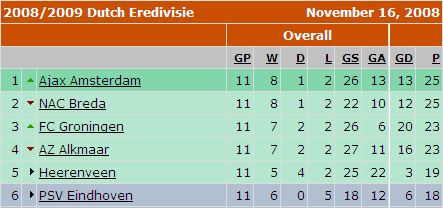
Long ago, it was typical to see for Ajax to lose to PSV in the Arena. Every time, it seemed, it was PSV which had the home ground advantage in Amsterdam. It was as if moving to the Arena from De Meer was a huge mistake. The magic was gone and Ajax cursed.

That trend was not seen today.

Ah, look at it…

Modified screenshot from Soccernet.

Is it not beautiful?

It does look kind of tight though. One slip and there goes the top spot.

Categories
Personal

[1833] Of damn it all!

How does it feel to have spent days thinking and hours writing only to realize when you closed the application, you failed to save it?

Categories
Books, essays and others Society

[1832] Of infected by Western ideology

I thought, the following words in the Dreams from My Father describe something also relevant to the Malaysian society.

“Truth is usually the best corrective”, Rukia said with a smile. “You know, sometimes I think the worst thing that colonialism did was cloud our view of our past. Without the white man, we might be able to make better use of our history. We might look at some of our former practices and decide they are worth preserving. Others, we might grow out of. Unfortunately, the white man has made us very defensive. We end up clinging to all sorts of things that have outlived their usefulness. Polygamy. Collective land ownership. These things worked well in their time, but now they most often become tools for abuse. By men. By government. Any yet, if you say these things, you have been infected by Western ideology.” [Barack Obama. Dreams from My Father]

Not too long ago, I remember Malaysian politicians — religious conservatives too — accusing those who think disagree with various government policies and various traditions as being influenced by Western ideology.

Categories
Economics

[1831] Of the quicksand of Keynesianism

Over 70 years after The General Theory on Employment, Interest and Money was published, Keynesianism now holds sways over macroeconomic thinking. Neo-liberalism almost made Keynesianism as obsolete as communism but the tradition of The General Theory proved to be resilient. Resilient as it may be, there are dangers in following the track of Keynesianism and it is certainly not the only option available out there when it comes to facing economic downturns.

Keynesianism, despite its wide explanation of the economy, is best known as the idea which advocates the state taking an active role in managing the economy. In times of uncertainty, the idea that the government needs to spend to pick up the slack in the economy has again regained currency. The Abdullah administration recently introduced an economic stimulus plan worth RM7 billion, announced by the new Finance Minister Najib Razak, to do just that. The DAP proposed an even bolder move involving spending about 6 folds larger than the planned stimulus.

This happens at a time when the country is expected to experience its 12th consecutive fiscal deficit in year 2009.

During the first tabling of the 2009 Budget, the government projected a deficit of 3.6 per cent of the country’s gross domestic product. With lower energy prices as well as increased expenditure, the deficit can go only higher.

When Keynesians espouse deficit spending, they really mean a counter-cyclical fiscal policy in which the government increases its activities in the economy in times of crisis and cuts down the frictions it causes in the economy in good times. However, too many advocates of the policy, especially politicians, conveniently forget or even do not know what the Keynesian countercyclical fiscal policy is all about.

Not that I am advocating the true form of the Keynesian policy but clearly, many politicians subscribe to the narrative of countercyclical fiscal policy only in times of hardship. In better times, none of the action proposed by Keynesian economics is implemented. The continuous fiscal deficit is a proof to that. In all likelihood, the continuous deficit would merely impose a higher cost of borrowing on the country, forcing future generations to bear the burden of past mistakes.

It is true that fiscal deficit and debt in general is not necessarily bad. If borrowing today offers an opportunity for profits tomorrow, that borrowing might be a good idea. The problem with this country is that the government, instead of truly investing in public goods with more convincing multiplier effects like education, is more interested in investing in white elephants, or in the stock market, as evident in the RM5 billion injection into ValueCap through borrowing. It is things like this that make it imperative for us to be suspicious of politicians who seemingly adhere to the Keynesian school of thought.

It has to be noted that when Keynes wrote The General Theory, he was trying to save capitalism. On the contrary, politicians who inconsistently advocate for Keynesianism are not trying to save capitalism. In times of economic crisis, the political environment could be very dynamic and it is Keynesianism, out of several others, which has the potential of calming the electric atmosphere.

While I lament each time Keynesian economics takes centre stage, its effectiveness in smoothing the downside of capitalism is undeniable. There are side effects however.

The government is expected to finance the deficit and the fiscal stimulus through borrowings. The Finance Minister has indicated that the government will mostly obtain the funds from local sources. This effectively means that private enterprises will have to compete against the government in sourcing for precious capital. With the financial crisis well under way internationally, it is likely that the opportunity for local private entities, especially smaller ones, to borrow from abroad is small, leaving local sources as the only options.

This competition for capital only increases the lending rate as demand increases vis-à-vis supply of loanable funds. This has the potential of crowding out private investment. As a result, the private sector may miss out opportunities in times of a downturn and be unable to be as dynamic as it should during recovery times and during yet another era of exuberance.

Deficit spending may also defeat the purpose of the economic stimulus. With higher interest rates, it makes more sense for individuals to save rather than invest in various value-creation initiatives, with all else being equal.

This, in a way, makes countercyclical fiscal policy unhelpful. At least one paper — by Gordon and Leeper — highlights that. The paper states that “countercyclical policies may create a business cycle when there would be no cycle in the absence of countercyclical policies”.

Furthermore, if Keynesians are interested in fighting business cycles so selflessly, why do they not simply eliminate business cycles altogether?

Instead of trying to smooth out cycles after it happened, the Austrian school of economics seeks to inherently smooth business cycles by instilling discipline in monetary policy. While there is not much data to compare the effectiveness of the two schools, the Austrian theory, if business cycles are of concern, sounds far more superior to the Keynesian countercyclical action.

Finally, despite the level of comfort far too many people have when they confidently say that government spending is the only option available in facing an economic downturn, that statement is absolutely false.

One of them involves private rather than public spending. Malaysians — and East Asians in general — have a tremendous amount of private savings. A report states that the level of savings by Malaysians is well above 30 per cent of income. Policymakers could design a policy which takes advantage of that fact. Indeed, the reduction of worker’s contribution to EPF from 11 per cent to 8 per cent is one policy which takes this path.

Others include permanent tax cuts to encourage businesses and enhance disposable income or even simply let the market eliminate unprofitable ventures made unwisely to give other promising ventures a shot.

Mohd Hafiz Noor Shams. Some rights reserved Mohd Hafiz Noor Shams. Some rights reserved Mohd Hafiz Noor Shams. Some rights reserved

A version of this article was first published in The Malaysian Insider.