Categories
Sports

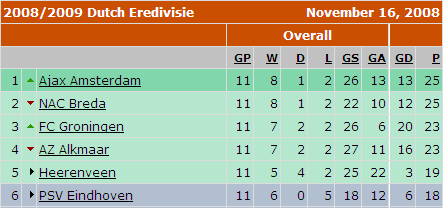
[1834] Of Ajax now tops the Eredivisie for the first time in ages!

They did it in style too by demolishing PSV 4 to 1 in Amsterdam.

Long ago, it was typical to see for Ajax to lose to PSV in the Arena. Every time, it seemed, it was PSV which had the home ground advantage in Amsterdam. It was as if moving to the Arena from De Meer was a huge mistake. The magic was gone and Ajax cursed.

That trend was not seen today.

Ah, look at it…

Modified screenshot from Soccernet.

Is it not beautiful?

It does look kind of tight though. One slip and there goes the top spot.

Categories
Sports

[1830] Of meanwhile back in the Eredivisie

This season of the Eredivisie has been extraordinary. It began with none of the traditional Big Three at the top. Two of them lingered in mid-table while another dangerously lurked at the bottom. Sure, it was early and panic would be excessive. But with about two-thirds of the season to go, the Big Three collectively are struggling.

Ajax only recently found themselves fighting their way back to the top. Currently third, there is a good chance that Ajax will move to the second place after today. Already the result shows that Ajax is leading by 2 goals against Sparta Rotterdam. PSV is right behind Ajax but with the recent shocking loss to NEC Nijmegan yesterday, Ajax should be able to build up some cushion away from PSV.

The saddest of all of the Big Three is Feyenoord. The traditional rival to Ajax has not been well for the past few season but this year is probably one of the worst for Feyenoord. It is unlikely for Feyenoord to mount any reasonable challenge to the title as well as for places in the Champions League and the UEFA Cup.

Ajax has been impressive so far since it is troubled with injury and suspension. And this is also despite the fact that performance on the pitch is not so convincing. One could actually wonder how the hell Ajax has been so lucky so far.

In any case, the leaders of the table from Day 1 to now have been unexpected. Groningen, NEC, Twente. These teams are proving that they are not scared of the Big Three anymore and certainly, not of Feyenoord at all. The kind of disrespect they have shown Feyenoord is hair-raising.

I am unsure if these teams have gotten better over the years. It is probably more of a case which the Big Three have not been performing, with Feyenoord representing an extreme case. The performance of Dutch teams in European competition is another point which supports this hypothesis.

Mediocrity has made this season one of the most egalitarian version of the Eredivisie. This is simply sad but the socialists are probably celebrating. (Heh. I cannot help it. Their penchant for wealth egalitarianism is missing the larger picture.)

There is another team that probably has demonstrated consistent improving and that is AZ Alkmaar. Currently second and mostly like to come out first at the end of today, AZ under former Ajax manager, Louis van Gaal. With Feyenoord floating like a deadwood in the Rhine, AZ is likely to assume Feyenoord’s position as the feared Dutch-trio.

Looking at the Eredivisie so far however, it is hard to say the term Big Three without incredulity. The first and the fifth placed team are only separated by 5 points.

Mohd Hafiz Noor Shams. Some rights reserved Mohd Hafiz Noor Shams. Some rights reserved Mohd Hafiz Noor Shams. Some rights reserved

p/s — after the dust settles for the week, three teams at top — in the order of AZ, Ajax and NAC Breda — share the same points, separated only by goal difference.

Categories
Economics Sports

[1793] Of Fortis sponsors Feyenoord

Now I know why Fortis sounds so familiar.

Categories
Sports

[1792] Of OMG! OMG! Michigan won!

This is truly a pleasant surprise. Michigan won against No. 9 Wisconsin!

Frankly, embarrassingly, I had expected Wisconsin to steamroll pass Michigan and take their first win in Ann Arbor for the first time since 1994. The reason is the Wolverines are in a bad shape this season, especially with the departure of key players as well as Coach Carr at the end of last season. So far, Wolverines supporters has justified the sorry state by calling this season a season of rebuilding.

And this is a shameful admission: I did not watch the game exactly because the expectation against Wisconsin was set so low. So, imagine my genuine surprise when the first message of the day I received through my cell is the word, “we won”. That two-word message brought my Sunday to a whole new ecstatic level.

However, despite the win, the game was so bad that Michigan got booed by our own supporters!

ANN ARBOR, Mich. (AP)—Rich Rodriguez earned the right to be hailed at Michigan for the first time.

Rodriguez, in his fourth game as coach, directed the Wolverines’ biggest comeback in Big House history, helping them rally from a 19-point deficit to beat No. 9 Wisconsin 27-25 Saturday.

The first significant victory of his debut season in Ann Arbor wasn’t sealed until Allen Evridge misfired on a 2-point conversion with 13 seconds left.

“Never had a doubt,” Rodriguez joked.

It didn’t seem like the Wolverines were going to have a chance to celebrate their 500th game at Michigan Stadium when they had five turnovers, trailed 19-0 and were booed off the field at halftime. [Call it a comeback: Michigan beats Wisconsin 27-25. Larry Lage. AP via Yahoo! Sports. Saturday 27 2008]

I would have never booed my own team. Angry, yes but booing is out of the question. I am glad to say that I have never booed the team in The Big House, even when Michigan was poised to lose to Michigan State in 2005. We did not lose that one because we made the biggest come back that demanded 3 overtimes.

In the Big Ten, only Penn State and Northwestern are undefeated. Penn State is okay but Northwestern, well, no offense to Northwestern everybody knows Northwestern is a pretender. They are up there because of their unimpressive schedule. That will change next week when they meet little brother Sparties next week.

In any case, the win was really handed over to Michigan by the Badgers. But a win is still a win. And there is hope now!

Here is to Monday, for a ranked Michigan for the first time in many months.

Categories
Economics Sports

[1751] Of they counted it wrongly

Notwithstanding Tibet, the conflict in Xinjiang, suppression of Falun Dafa, the alleged connection to the alleged genocide in Darfur, broken promises of a free press, the pollution and eviction of citizens from Beijing, or the less than flattering revelation of how the “live” opening of the Olympics was not quite as “live” as it should have been — not to mention the use of a substitute child lip-syncing the song at the opening ceremony because the actual singer was not pretty enough — another phenomenon which this Olympics will forever be associated with is the competition between the United States and the People’s Republic of China. The methods used to measure the competition at the moment are flawed however.

The Olympics, in a way, can be seen as a proxy battle between the world powers. Prior to the Second World War, the United States was up competing against Germany. The battle was conclusively settled outside of the stadium in 1945 in Berlin.

During the Cold War, it was the US against the Soviet Union. As the Soviet Union crumbled under its own weight, so did the competition between the US and the USSR. Today, it is the PRC versus the US.

The competition between the US and the PRC is not just in the courts of sport. It can also be seen in how the points are tallied and, subsequently, how ranks are determined.

Go to the official website of the Beijing Olympics, head over to the medal count table and immediately a visitor can observe how the count is carried out. At the site, a gold medal is the ultimate yardstick. Regardless of quantity of bronze and silver medals, if a country has more gold medals than the other, the country gets to be on the top.

Head over to any Olympic standings published by the US press and there is a good chance that a person will find that countries are ranked by total medal count, regardless of the value of gold, bronze and silver. That is how the New York Times, FoxNews and MSNBC do it, anyway.

I am unsure how far the different ways of assigning ranks relate to competition between the US and the PRC but it is tempting to attribute the difference to the rivalry between the two countries. Another possibility is that this could be an innocent systematic difference.

A quick check of the official standings of previous editions of the Olympics reveals that it is gold medals that count, not total medals. In the 2000 Sydney Olympics, for instance, Ethiopia ranked 20th with four gold and eight total medals while Ukraine held the 21st place with three gold and 23 medals in total. The US ranked first, having the most gold and total medals.

The same arrangement is true for the 1996 Atlanta Olympics. Italy ranked 6th with 13 gold and 35 total medals while Australia ranked 7th with nine gold but 41 total medals. Just as with the 2000 edition, the US reigned supreme by garnering the most gold as well as total medals.

I am unsure how the US media did their rankings for the 1996 and the 2000 Games. Therefore, I cannot comment on the consistency of the US media but it is safe to say that the official convention at the Beijing Olympics is in line with past practice.

One way to see if bias has played a role in the determination of ranks would be to see if changes of circumstances of standings under a particular convention would lead to changes of convention.

Regardless, each convention suffers from a serious flaw respectively. Are 50 bronze medals worth less than a single gold medal? Is a gold medal worth as much as a bronze or a silver medal?

Surely the answer is no to both questions.

Yet, under the gold convention as officially adopted at the 2008 Olympic Games, the answer is yes to the first question and no to the second question. Under the total medal convention as adopted by the US media, the answer is reversed.

Truly, all participants actually care about winning a medal and what kind of medal. Gold is obviously the most favoured medal. Silver is not bad too if gold is out of reach. And better bronze than nothing, do you not think so?

The fact that participants compete for these medals and obviously hold transitive preferences for each type of medal insists that both types of ranking adopted by the Beijing Olympics and the US media are flawed. If the rankings are not flawed, then the principle of microeconomics would have to see a complete overhaul!

It would be the end of economics as we know it.

Seriously!

For those who truly wish to right the wrongs of the world, we can begin by restructuring the way countries are ranked in the Olympics. Weight to medal should be assigned to reflect the transitive nature of preference for different types of medals.

We could assign three points for gold, two for silver and one for bronze. The sum of points would then determine the final standings.

I think this is a worthy cause to fight for. I shall take up my dissatisfaction against the IOC by protesting in front of their headquarters soon. So, who is with me?

Mohd Hafiz Noor Shams. Some rights reserved Mohd Hafiz Noor Shams. Some rights reserved Mohd Hafiz Noor Shams. Some rights reserved

A version of this article was first published in The Malaysian Insider.