Categories
ASEAN Politics & government

[748] Of a bridge, some airspace and a whole lot of sand

I’m not sure how to react to the announcement that Malaysia and Singapore have agreed in principle to build a straight bridge in order to replace the Causeway. Reason is, Malaysia relented on two points: airspace and sand supply.

In return of Singaporean cooperation for a straight bridge, Singapore wants to use Malaysian airspace to train its air force and a guaranteed sand supply to continue its reclamation projects. Without going too deep into the issue, I’d say this as highly unreasonable; I feel it’s impossible to meet. That impossible demands and the need to fuel economic growth in southern Malaysia are the reasons why I support a construction of a bridge to replace the Causeway, without Singaporean cooperation.

Concerning air space, I simply don’t trust the Singaporean government and their military even less. Hell, I don’t trust my own government. Singapore says it wants to use Malaysian airspace for training purposes. However, it isn’t too hard for Singapore or anybody for that matter to turn this little maneuver into some sort of espionage missions. I don’t know what high value targets are there in Johor but I bet Singapore would know if Malaysia is to allow Singapore to conduct “training” in Malaysian Johor airspace.

More interesting is sand supply. Singapore has been aggressive in reclaiming lands from the sea; the reclamation projects have attracted Malaysian and Indonesian attention. Both have expressed concerned about the projects but Singapore ignored it. Malaysia was especially concerned with Singaporean reclamation at Tuas in the west and at Pulau Tekong in the east; both border Malaysian state of Johor. In 2003, both countries went to the International Court of Justice to resolve the issue once and for all. The ICJ in turn sided with Singapore with reservations.

Regardless of the result, it doesn’t matter because Singapore had to stop its reclamation effort, thanks to Indonesia. Previously, Indonesia provided the raw materials Singapore needed for its reclamation project. Like Malaysia, Indonesia was suspicious of the Singaporean effort. In the end, Indonesia cut off the supply, fearing Singapore redrawing the Singaporean-Indonesian border. The projects are still on hold. Now, Singapore needs to find a new source of sand. And guess who Singapore is turning to now?

If Malaysia agrees to supply Singapore the sand, it would be an odd thing to do. Malaysia is against Singaporean reclamation project. For Malaysia to supply the sand and enable Singapore to continue a project that Malaysia is so vehemently disagree of, is, again, odd. It defies logic.

Perhaps, this is because Malaysia knows that Singapore could get the sand that its need from somewhere else. We know how Singapore managed to buy a company of strategic importance in Thailand. Given that, it wouldn’t be hard for Singapore to get some sand from Thailand. Maybe here’s is just Malaysia doing a “hey, why not make some money out of it?” act.

Unless Singapore could sweeten the pot – like allowing Malaysians that work in Singapore to withdraw money that the Singaporean government has been withholding – I definitely believe a crooked bridge is a better deal. Of course, a straight bridge is good but circumstances make it not too favorable.

With the bent bridge, Malaysia gets a little less of what it wants without giving Singapore anything. If Malaysia accedes to Singaporean demands, Malaysia would get what it wants by giving too much to Singapore.
Categories
ASEAN Politics & government

[747] Of bridge of euphemism: ignoramus

If a person plans to take side on an issue, it’s extremely wise to comprehend the situation first. Failure will bring ridicule and signals ignorance. Here, I wish to highlight a surprisingly ignorant reason why some people are opposing the crooked, scenic Malaysian half-bridge. These people are opposing the bridge because they think the bridge will end in the middle of the Tebrau Strait. In truth, the bridge will be connected to the Causeway and it’s not a multimillion culdesac.

Let me show you.

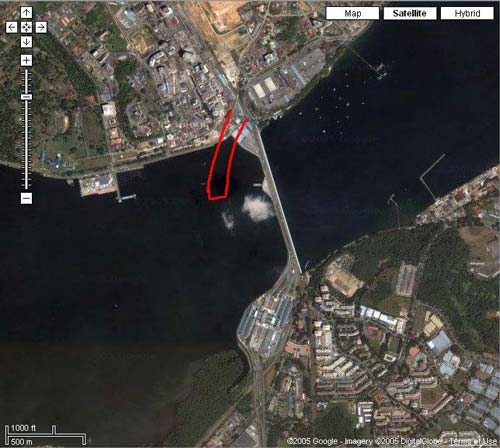
People think the bridge would be like this:

Google Maps. Fair use. http://maps.google.com/?ll=1.454803,103.768444&spn=0.01922,0.029268&t=k

People who have this picture in their mind will always say with scorn that we would need to swin to Singapore once we reached the end of the bridge.

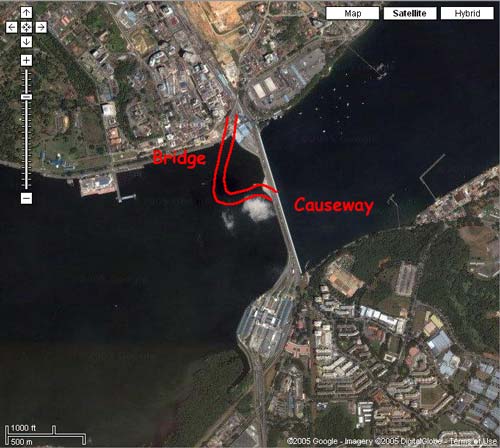
In reality, the bridge will look like this:

Google Maps. Fair use. http://maps.google.com/?ll=1.454803,103.768444&spn=0.01922,0.029268&t=k

Image taken from Google Maps. I hope it qualifies as fair use.

As you can see, it’s a half bridge because it’s half a bridge and another half a causeway. Not one part bridge and the rest, water. There’s no need to swim and suffer being wet to get across the strait unless you really love swimming.

Don’t believe me? What? Me? A liar? What? Me, a BN lover?

No, I’m being pragmatic. There’s no need to be a rebel without a cause; a rebel that protests to everything for the mere sake of rebelling – that’s an insincere protest. It’s immature and stupid. Much like those in the price hike protest. In the Star last Friday, there was an article about the bridge. The writeup has a picture of the bridge plan and here’s the picture:

The Star. Fair use. http://thestar.com.my/news/story.asp?file=/2006/3/10/nation/13623928&sec=nation

Observe the rightmost diagram. See it?

As to why it’s crooked, well, it’s the only way to gain a required height – in this case, 25 m (25 m is also the air draught for the Second Link to the west) – given the length constraint due to Singaporean refusal to demolish their half of the Causeway. If Singapore had agreed to a bridge and demolish their part of the Causeway, the bridge wouldn’t need to be crooked in order to obtain that 25 m. Once the bridge is completed, Malaysian half of the Causeway will be demolished and the bridge will be linked up to Singaporean half.

I hope this will clear things up for all those ignoramuses out there, particularly those at Lowyat.net’s Real World Issues forum.

Heh, the ignoramuses have already zipped their mouth by the time they found out that the bridge won’t end in the middle of nowhere. If it did end in the middle of nowhere, even I would vehemently disagree to it. But it is not and I fully support the Malaysian initiative.

Next time, really, learn the issue first. This includes the price hike but that’s another story I’ll chance another time.

Categories
Activism ASEAN Politics & government Travels

[737] Of trouble to the northeast

Filipino President Gloria Macapagal Arroyo has officially declared a state of emergency in the Philippines after a coup plot was uncovered:

MANILA (Reuters) – President Gloria Macapagal Arroyo invoked emergency rule in the Philippines on Friday after security forces said they had foiled a coup attempt, shocking analysts and driving down the country’s currency.

Talk of plots against Arroyo, who survived a crisis last year over allegations of vote-rigging and corruption, has been running high around this week’s anniversary of a “people power” revolt that toppled dictator Ferdinand Marcos in 1986.

“I have declared a state of emergency,” Arroyo said in a taped address on television and radio, adding she had authorized the military and police “to take ample measures”.

“This is my warning to those who are attempting anything against the government.”

I say, Arroyo needs to step down already. It’s becoming more apparent each day that Arroyo has little popular support from the masses. With all the controversies centered around her, I bet the Philippines would solve a lot of problem with her stepping down.

With there’s already trouble to the north of Malaysia (read, Thailand), Malaysia doesn’t need another unstable neighbor.

p/s – remember the great flood of Pasir Kumpal? Well, some people got back there and Pelf has some pictures.

Categories
ASEAN Politics & government

[718] Of bridge of euphemism

So, in truest form of doublespeak, a crooked bridge has become a scenic bridge. Shakespeare would say, what’s in a name? Despite the doublespeak, I fully support the idea of a bridge, bent or otherwise.

In my opinion, the only reason Singapore is being impossible is because an opening of Tebrau Strait would enable Port of Tanjung Pelepas (PTP) in Johor to seriously challenge Port of Singapore. The growth of PTP has already alarmed the Singaporean government. For the past few years, several of the world’s largest container ship operators like Maersk and Evergreen have migrated from Singapore to PTP. According to Wikipedia, Maersk’s migration alone represented a 10% drop in business at Singaporean ports.

PTP is growing because it’s a cheaper alternative to Singaporean ports. And it’s growing in spite of the Causeway. Imagine if there were no causeway to prevent sea travels. With clear lines connecting PTP with two other Johor ports in the east – namely Johor Port at Pasir Gudang and Tanjung Langsat Port – PTP would become an even larger entrepot. That itself would encourage PTP to grow even further and faster.

I’m sure the Singaporean government know this and I suspect they’re trying to slow PTP’s growth down. Today in Utusan Malaysia, an article suggests that Singaporean reclamation projects at eastern and western reach of Tebrau Straits might be Singapore’s effort to prevent the strait from becoming a viable sea route. That article helped me sealed my suspicion. After all, narrowing the strait is the surest way to keep PTP and other Johor ports’ growth in check.

Singapore insists that construction of a bridge replacing the Causeway must bring benefit to both sides. However, opening up of the strait will hurt Singaporean trade. Given that, Singapore refusal to agree to a bridge is comprehensible, no matter how frustrating it is. So, when Singapore said it’s not benefiting from the construction of the bridge, Singapore is telling the truth. More importantly, a convoluted truth because Singapore is applying a false dilemma fallacy. The result of “no bridge” has already been guaranteed when they supplied the condition. And not to forget, this is done on top of other nonsense reasons such as traffic volume into Singapore, higher toll and how Goh Chok Tong is feeling nostalgic about the Causeway given by Singaporean government.

A false dilemma is the appearance that only two choices exist when in fact, there are other explorable options. For instance, if Singapore refuses to replace its half of the Causeway, Malaysia could demolish its half and then replace it with a crooked bridge, which is what Malaysia is doing.

A crooked bridge is an unfortunate political turn. Nonetheless, I believe it is important for Malaysia to take our economy into own hands instead of the Singaporeans’. We should never make ourselves as somebody else’s hostage. This bridge is us driving forward. This bridge is us giving the Tebrau Strait back its life.

Categories
ASEAN Economics Liberty

[706] Of Cambodian dictatorship and ASEAN

Malaysia and several other ASEAN members have been criticizing Myanmar for the latter’s lack of meaningful democratic progress. To the southeast beyond Thailand, lies Cambodia with a dictator is in the making. Despite Cambodia’s alarming progress towards dictatorship, ASEAN leaders are yet to say a word about it.

For the past few days, Cambodian government have been arresting Cambodians critical of the government on the ground of defamation. The arrest has sparked condemnation from several organization, including Amnesty International. AI in its press release accuses the Cambodian government of manipulating Cambodian courts. The New York Times in one of its articles says that this is not an isolated incident. Opposition leaders and others have been arrested by the government. This makes these arrests as a part of a larger erosion of freedom in Cambodia:

Cambodian Leader Cracks Down in Bid to Solidify Power
By SETH MYDANS
Published: January 9, 2006

PHNOM PENH, Cambodia, Jan. 8 – The harshest political crackdown in years is under way here in what some analysts are calling the final stage in Prime Minister Hun Sen’s drive to consolidate unchallenged power.

Over the past year, he has choked off the last effective political opposition while continuing to marginalize the monarchy, manipulate the courts and intimidate labor unions and other civic groups. In December, the leader of the only significant opposition party, Sam Rainsy, who had already fled the country, was sentenced in absentia to 18 months in prison for criminal defamation.

Now, with a series of arrests and lawsuits on defamation and related charges, Mr. Hun Sen is for the first time directly attacking the human rights groups that, by default, serve as a de facto democratic opposition…

ASEAN has a unique role to apply pressure against Cambodia. The 10-member confederation could admonish the Cambodian Prime Minister Hun Sen and perhaps, put a check on current Cambodian political atmosphere. But it is not doing so and I think I know why they are silent on the matter.

ASEAN takes pride of its non-interference policy but it makes an exception for Myanmar thanks to US and EU initiative. Unlike Myanmar, the European Union and United States are not pushing ASEAN to deal with Cambodia accordingly. With no outside push, ASEAN seems happy to stay away from making a comment on its members. Well, I think it’s just wrong and ASEAN needs to make a statement on Cambodia.

The reason for such need is simple – it’s the ASEAN Charter which guarantees human rights. Though the Charter has yet to be drafted, this is a chance for ASEAN to prove to the world and more importantly, to its own citizens that the charter will not be just another piece of paper. If ASEAN fails to speak up against Cambodia, it will be harder to deal with such case in the future even when the Charter is in place.

Then, of course, besides the lack of outside pressure, another reason why ASEAN is not doing anything about the issue is because its more prosperous members, particularly Malaysia, Singapore and Thailand, are not quite saints when it comes to human rights.

p/s – Volkswagen ends partnership with Proton. So, Proton is going to keep Lotus after all.